
Sheffield 2026: 36 Under-12 Children and the Underground Pipeline Feeding World Table Tennis
**Core answer**: ITTF World Hopes Week & Challenge 2026 là trại huấn luyện và thi đấu U-12 toàn cầu của ITTF, tổ chức tại English Institute of Sport, Sheffield, với 18 nam và 18 nữ đến từ 26 quốc gia; đây là khâu cuối của lộ trình tuyển chọn Hopes Programme, không tính điểm xếp hạng. **Key facts**: - 36 vận động viên U-12 (18 nam, 18 nữ) từ 26 quốc gia, đại diện năm châu lục. - Địa điểm: English Institute of Sport, Sheffield, Anh. - Hai suất của chủ nhà Anh: Sai Prasanna Kumar và Isabella Xiao Xu, qua England Hopes Challenge. - Tiêu chí đánh giá gồm năng lực kỹ thuật, thái độ tập luyện và tiềm năng phát triển, không dựa trên kết quả. - Không có điểm xếp hạng và không có tiền thưởng; chọn vào Hopes Team mở đường nhanh vào lộ trình hiệu suất cao. **Source attribution**: Nguồn: Table Tennis England (bản tin xác nhận danh sách của ITTF); ngày công bố gốc chưa được xác minh trong tài liệu tham chiếu. **Related Q&A**: - Hỏi: World Hopes Week có tính điểm xếp hạng ITTF không? Đáp: Không, đây là sự kiện phát triển tài năng, không cấp điểm xếp hạng hay tiền thưởng. - Hỏi: Vận động viên vào Hopes Team được gì? Đáp: Được mở con đường nhanh vào lộ trình huấn luyện hiệu suất cao của liên đoàn quốc gia mình. - Hỏi: Lộ trình để tới World Hopes Week gồm những bước nào? Đáp: Vòng tuyển chọn quốc gia, sau đó chương trình Hopes cấp châu lục, rồi tới tuần lễ toàn cầu tại Sheffield.
A Shaking Hand at the Edge of the Table
In 2026, in a gymnasium in Ha Dong, I stood about two metres from table number three and watched an eleven-year-old boy prepare to serve. His wrist was shaking. The hall was indoors and the air conditioning was running, so the tremor did not come from cold. It came from the place I have only ever seen in people about to step into something larger than themselves. He tossed the ball, it left his palm, and the shaking vanished the instant the rubber met the plastic.
I bring that up for a reason. This week, in an industrial city in northern England, thirty-six children under twelve are preparing to step into exactly that moment. They come from 26 countries across five continents. They will sleep under one roof, eat at one table, train under one row of lights, and play a tournament in which none of them will earn ranking points, none will receive prize money, and none will be entered into any roll of honour. That is precisely why I think this event matters far more than the way it is being reported.
26 Countries, 36 Names, and a Week Without a Scoreboard
The ITTF World Hopes Week & Challenge 2026 takes place at the English Institute of Sport in Sheffield, with the final list confirmed by the International Table Tennis Federation and announced by Table Tennis England in the association's newsroom brief. The field is 18 boys and 18 girls, all in the under-12 category — the youngest age band for which the ITTF maintains a systematic international identification programme. Host nation England has two qualifiers: Sai Prasanna Kumar and Isabella Xiao Xu, both of whom came through the domestic England Hopes Challenge.
The English Institute of Sport in Sheffield is a British high-performance training facility that has hosted national squads across several sports. A venue like that opening its doors to a group of eleven-year-olds for a residential week is not a trivial detail. It shows how world table tennis sees itself at the very base of the pyramid.
Formally, this is a camp combined with competition. Over seven days, the children go through guided technical training, movement assessment work, and an internal event called the Challenge. There is no knockout bracket of the kind we know, no seeding, no published results table. The programme's coaching staff assess the children across three pillars: technical ability, training attitude, and overall development potential. Whether a child wins or loses that week is not among the three pillars.
I have covered table tennis since before I moved into esports, and across all those years I learned something I have to say plainly: fans in Vietnam know very little about what happens before an athlete appears on television. We know the winner's name, we know the medal moment, we even memorise certain defeats. We rarely know about the week in which a child is first taken away from home, from the province, from the country, and placed in a room with thirty-five other children who are all as good as they are. Weeks like that are where careers are decided, or broken.
The Pipeline Architecture: From Home Court to Hopes Team
To understand the week in Sheffield, you have to look at the pipeline behind it. The ITTF Hopes Programme runs on four successive layers, each with its own filter.
Layer one is national qualification, such as the England Hopes Challenge, where member associations organise their own search for the brightest under-12 talents on their territory. Layer two is the continental Hopes programmes, run across five regions: Europe, Africa, Asia, the Americas and Oceania. Those continental programmes are the filter that decides who flies to England. Layer three is the World Hopes Week & Challenge, the global residential camp. Layer four is the Hopes Team: a small group selected from that week, whose admission unlocks a fast-track route into the relevant country's high-performance pathway.
Based on my experience of watching matches and youth events over many years, I draw one conclusion I believe is central: the genuine analytical value of this event lies in its institutional architecture, not in technique. Anyone attempting to read playing styles, tactical systems or loop quality out of this brief is inventing. At under-12 level, meaningful point-level technical data simply does not exist.
If you follow esports, you will recognise the model immediately. Riot Games has Scouting Grounds and an academy system; the LCK has Challengers League as a feeder tier. The crucial difference is compression speed. A League of Legends pro can be discovered at fifteen, play professionally at seventeen, win Worlds at nineteen. Table tennis does not allow that. An under-12 child in Sheffield, if everything goes well, is still eight to ten years away from a realistic first senior Olympic appearance.
Eight to ten years. Think about that for a moment. In that span, an esports professional has completed a career, retired, moved into streaming, and then into coaching. The child in Sheffield is still mid-pipeline, still re-evaluated every year, still not allowed to know whether they will reach the end. This is why table tennis is one of the most psychologically brutal sports at youth level, and why what the ITTF is doing in Sheffield deserves a closer look.
Another comparison, closer to home for Vietnamese readers: China's provincial model. There, the identification system is almost closed and self-sufficient. A ten-year-old in a provincial town is spotted, moved into a sports school, and lives inside a structure that can last a decade, with all resources coming from the state. That pipeline is devastatingly effective in output terms, but it is not available to countries without that institutional machine. The ITTF Hopes Programme is the counter-model: an open funnel, accessible from outside, where a small federation in Chile or Uganda still has a documented route to place one of its own into the elite system.
Why "No Results-Based Assessment" Is the Most Important Technical Decision
Of everything in the Sheffield brief, the sentence that stopped me longest was the one about assessment criteria. The organisers state clearly that selection rests on technical ability, training attitude and overall development potential, not on competitive results. Journalists usually read that line as a polite educational gesture. I think it is the most important technical decision in the entire programme, and it stands on a specific biological foundation.
At eleven or twelve, children of the same chronological age can differ by three or four years in biological age. An early developer may be half a head taller, longer in reach, stronger in the wrist, and will therefore win almost every youth match without being more skilled. A late developer, by contrast, may already possess better ball feel, finer spin reading and unusual composure — but keeps losing because the body has not caught up with the mind. Select on results at this age and the system will repeatedly discard exactly the people who most need time.
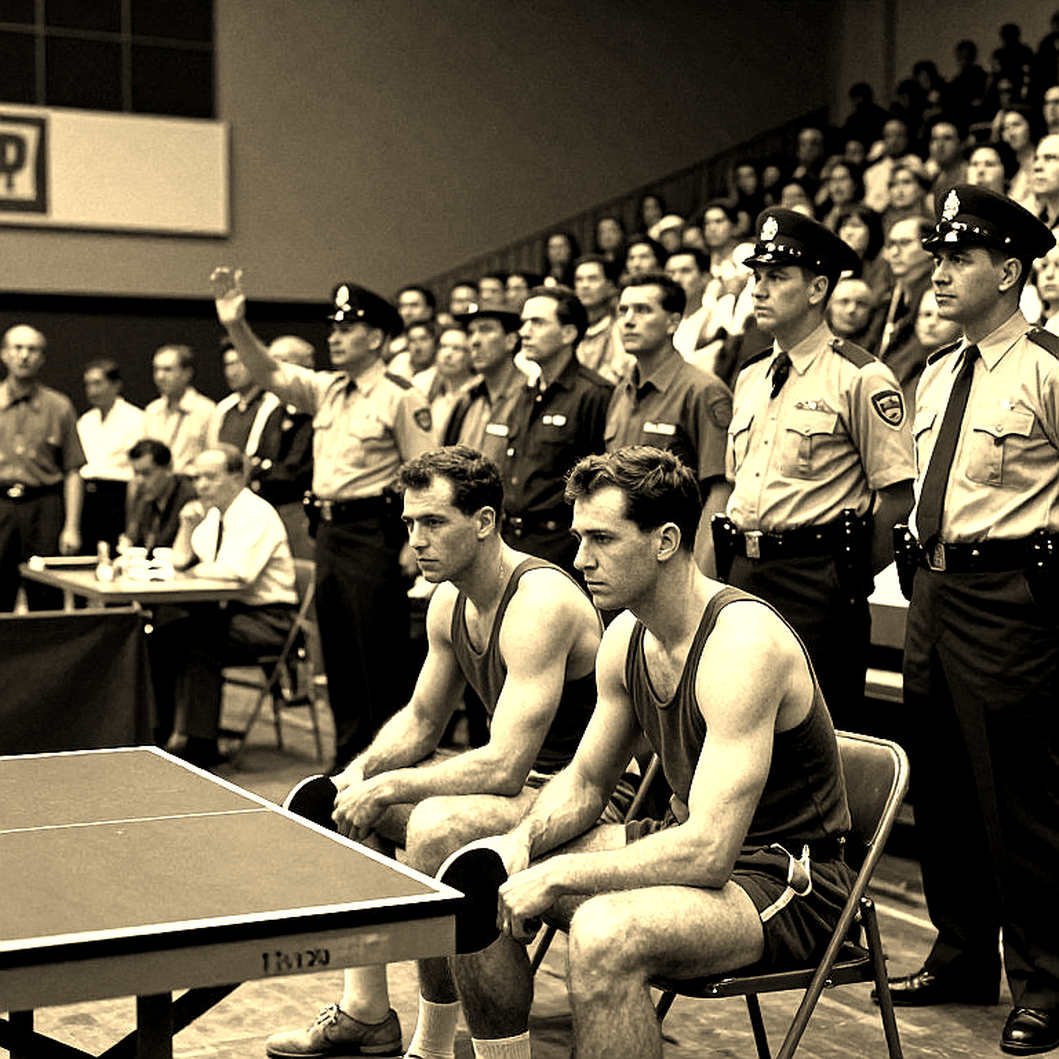
The principle has a name in international sport documentation: long-term athlete development. It recommends that children experience multiple sports, multiple movement patterns and multiple forms of pressure before specialising. Early specialisation in table tennis carries a concrete cost: it locks in technical structure before the body stabilises, creating motor patterns wired so deep into the nervous system that they can no longer be corrected later. A loop built on the physical foundation of an eleven-year-old becomes a technical debt at seventeen.
That is why a week like Sheffield, professionally speaking, resembles a medical examination more than a tournament. Coaches watch how a child responds to having their technique corrected. They watch how the child stands waiting for the ball, how they handle a hard ball on the fifth day when tired, how they look at the coach when asked to repeat a drill for the tenth time. No scoreboard captures that data.
On equipment, at this level the children are almost certainly not using senior-tier custom blades and rubbers. Development-tier equipment is the norm, and that is deliberate. Professional table tennis splits into playing styles: loop-drive combined with fast attack, fast attack combined with loop, pips-out styles, penhold. Each demands its own equipment set, movement structure and training path. Locking an eleven-year-old into one of those is a decision world table tennis has learned to postpone as long as possible.
I once watched Levi shake on a big stage. That shake is what made him a legend. But Levi at nineteen was already an athlete forged inside a system with a clear funnel. Watching an eleven-year-old's hand tremble is a different story. At that age, the tremor is not yet a sign of nerve being forged. It is simply a nervous system learning to carry pressure, and the job of the adults in the room is to make that learning less damaging.
The Geography, and the Story the Brief Does Not Tell
The Table Tennis England brief stresses that participants come from every part of the globe, and lists a few examples: New Zealand, Canada, Chile, Malaysia, Uganda, Finland. Together with host England, those names form a distinctive set. I read that list and immediately thought of what analysts call emerging-market signals.
New Zealand and Finland are small table tennis markets with stable club systems. Canada has a substantial table tennis community but is always overshadowed by mainstream North American sports. Chile represents South America, a region that has never had a voice at elite table tennis level. Malaysia is one of the Southeast Asian nations with a relatively durable table tennis tradition. Uganda is the name that caught my attention most, because Africa has been almost entirely absent from high-level table tennis for decades.
Those names tell me that the Hopes Programme measures success by reach, not by the presence of traditional powerhouses. That is a design philosophy very different from how professional events operate. At senior level, a tournament is judged by how many stars it has. At this level, a programme is judged by how many countries it touches that have never been there before.
What the brief does not say is whether China is participating. I have to be explicit: nothing about this can be concluded from the available source. The brief does not list all 26 countries, only a few illustrative examples. Inferring that China is absent because its provincial system is self-sufficient is plausible but unconfirmed. In this profession I learned that an information gap must be recorded as a gap, not filled with a sentence that sounds reasonable.
I also have to be blunt about one line in the brief. The passage stating that the spread across continents reflects the truly global reach of the Hopes Programme is the only evaluative sentence in the entire document. It is reasonable, but it is programme advocacy, not independent analysis. The brief reveals no strength distribution between countries, no results, no seeding, no comparisons. A list containing Uganda does not automatically mean Uganda is on par with the strongest table tennis nations in that list. It means Uganda has one child the programme found.
The Contrarian Angle: The Price of a Badge Given Too Early
When writing about youth events, there is a temptation I have seen too many colleagues fall into: turning a list into a prophecy. A name appears in an international under-12 squad, and instantly it is called a prodigy, framed as the next generation, loaded with an expectation it never promised. I believe this is the single most serious child-welfare risk in this entire story.
An eleven-year-old just placed on an international list will live with that label for years. At school, at the club, on table tennis forums, they become someone others expect to win. When they lose a domestic youth event, people start asking about stagnation. When they get injured at fourteen, people say the talent was wasted. Nothing in the natural development of a human being prepares a child for that kind of pressure.
But I do not want to stop at that familiar warning, because it sounds safe and everyone nods along. My contrarian point lies elsewhere: the very fact that selection is judgement-based makes it an unaudited black box. The three criteria — technique, attitude, potential — form a pedagogically sound standard. But they have no scale, no published weighting, and no appeals mechanism. A human-judged system operating behind closed doors always leaves room for things unrelated to table tennis to slip in: relationships between federations, the geopolitical priorities of continental programmes, pressure from a host nation's local sponsors.
I have no evidence that anything of the sort happened in Sheffield. The source confirms the list was approved by the ITTF, with no dispute referenced. But as someone who has watched selection processes for twenty years, I know that structural transparency does not equal individual transparency. Continental qualification is a clear rule. Who is chosen from among those who qualified is a human decision.
This leads to my second contrarian point, and it concerns the programme more than individuals. The term the brief uses to describe the benefit of Hopes Team selection is a fast-track route into the high-performance pathway. That is a beautiful promise. But a fast track only exists if someone maintains it after the week ends. That commitment depends on national associations, on their budgets, on whether they have enough coaches and facilities to turn one inspiring week into ten years of systematic training.
If a small federation brings a child to England, gives them the best week of their life, then takes them home with nothing changed, the fast track is just an administrative sentence. That is the question I will keep pursuing: what percentage of Hopes Team invitees actually appear in their national squads eight or ten years later?
There is one further dimension I want to raise, even though it sits outside technical analysis. England hosting the World Hopes Week is not only an act for the global good. It is a domestic soft-power move. A week with 36 international children in Sheffield gives Table Tennis England a story to promote its grassroots programmes, a reason for local media coverage, and a recruitment tool for its youth system. That is entirely legitimate. It is simply not what the brief says.
What I Actually Want to Know, and What I Do Not Want to See
In 2026, the tournament fell silent. I realised applause does not need a grandstand. That memory returns to me when I think about a week in Sheffield that may have no spectators, no broadcast, nobody photographing the children celebrating. Perhaps that is the best thing for these children. A week whose only value lies in being assessed by people who understand the craft, rather than by a media algorithm.
At 47, the newsroom told me to write what readers wanted. I started writing what they needed. And what table tennis fans need from this story is not a list of names who will become famous in ten years. What they need is to understand that behind every medal moment at professional level there is a chain of anonymous weeks like this one, designed by people who believe a child should not be judged by a scoreboard.
So I will follow the Hopes Team list published after the week ends. I will follow how many of those 26 national associations actually place these names into their national training systems within a year. And I will remember the trembling wrist of that boy in Ha Dong, to remind myself that every legend begins with an unsteady hand, and the only thing we can do for that hand is refuse to call it a champion's hand too soon.
If an eleven-year-old walks onto a court in Sheffield this week and serves with a shaking wrist, will we have the patience not to label them before they have had the chance to grow?