
Hoang 'Sao' from Qualifiers to Round of 16: What Lies Behind the Run at Phu Tho Arena
**Core answer:** Duong Quoc Hoang, Vietnam's No. 1 pool player, competes at the WPA Men's 10-Ball World Championship at Phu Tho Arena, Ho Chi Minh City, from September 19 to 26. Across three appearances he improved from qualifier exit to Round of 32 to Round of 16. The champion receives USD 80,000, about VND 2 billion. **Key facts:** - WPA Men's 10-Ball World Championship runs September 19-26 at Phu Tho Arena; Vietnam hosts for a second consecutive year. - Total prize fund is USD 500,000; the champion takes USD 80,000, roughly VND 2 billion. - Nearly 200 cueists from 40 countries compete under a call-shot 10-ball format that removes luck. - Vietnam fields five named players: Duong Quoc Hoang, Luong Duc Thien, Pham Phuong Nam, Nguyen Anh Tuan, Chu Viet Hoang. - Side events: Poison Saigon Women's 9-Ball Open (USD 90,000) and Box Billiards mixed-doubles open (USD 111,000). **Source attribution:** VnExpress, September 19, 2025 | Cross-checked: VuaBong.vn **Related Q&A:** Q: What is the call-shot rule in 10-ball pool? A: Cueists must nominate the ball and pocket before each shot, so accidental pots do not count. Q: How has Duong Quoc Hoang performed at this event before? A: He exited in the qualifiers first, then reached the Round of 32, then the Round of 16 across three appearances. Q: Is pool governed by the same body as snooker? A: No; pool falls under the WPA, distinct from snooker's WPBSA and WST frameworks.
Duong Quoc Hoang has appeared at the 10-ball world championship exactly three times. The first time, he exited in the qualifiers. The second time, he stopped at the Round of 32. The third time, he reached the Round of 16. Three appearances, three steps upward, with no step going down.
In a discipline where a single missed shot can erase hours of accumulated work, such a monotonic trajectory is rarely random. It suggests something more concrete: adaptation to a punishing rule set in which luck has no place. I have spent many years sitting with tables of numbers like that. Before trusting a number, I ask where it was born. The same way I look at a player before passing judgment.
The tournament Hoang is competing in is the WPA Men's 10-Ball World Championship -- an event co-organized by the World Pool-Billiard Association (WPA) alongside the Ho Chi Minh City Department of Sports, the Vietnam Billiards & Snooker Federation (VBSF) and the Ho Chi Minh City Billiards & Snooker Federation (HBSF). It runs at Phu Tho Arena from September 19 to 26 -- the second consecutive year Vietnam has hosted.
This is 10-ball, a branch of American pool, not snooker and not Chinese 8-ball. Scoring is rack-based, not point-accumulation. The total prize fund is USD 500,000, of which the champion receives USD 80,000 -- roughly VND 2 billion. The field brings together nearly 200 cueists from 40 countries. Alongside the main event, organizers scheduled two side events: the Poison Saigon Women's 9-Ball Open (September 21-25, USD 90,000 prize fund) and the Box Billiards mixed-doubles open (September 19-23, USD 111,000 prize fund). Combined, the tournament system reaches roughly USD 701,000.
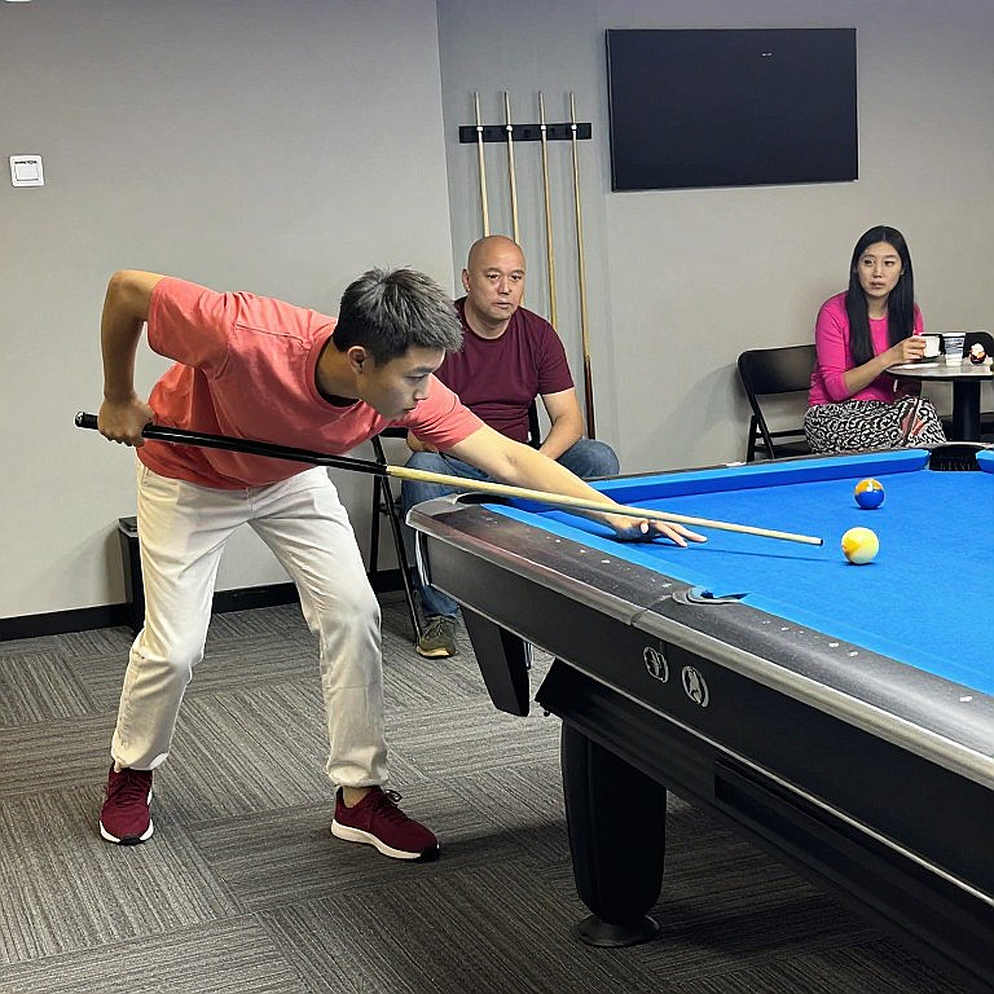
One detail receives little attention: the champion's USD 80,000 against the USD 500,000 total equals about 16 percent. That is a relatively flat distribution compared with world championships in other disciplines. It reveals a different payout philosophy: not everything is funneled to the top. One more distinction matters here: pool is governed by the WPA, entirely separate from snooker's WPBSA/WST. Any governance precedent, disciplinary case or incident from snooker carries no applicability here.
What stands out is not the number. It is the structure.
The call-shot rule is the technical spine of this event. A cueist must name the ball and the pocket before shooting. A ball that drops by accident does not count. This eliminates the luck factor that makes 9-ball more volatile.
I have followed many 9-ball matches in my role as a snooker commentator for VTC over 23 years. The difference between the two formats is not in the goals -- as in football -- but in how errors are punished. In 9-ball, a poor contact can still produce an advantageous position because balls drop randomly. In call-shot 10-ball, an error is punished by its own probability.
The consequence: this format rewards the more technically complete cueist, not the one riding a hot streak. And that turns Hoang's early exit to R32 to R16 trajectory into a more credible signal than it appears on the surface.
I have no data on his potting rate or run-out rate. The source article does not provide it. That is something I always check before drawing conclusions -- and it is also why I do not rush to say "Hoang is a title contender."
What the article does have: nearly 200 cueists, 40 countries, a knock-out format (most likely), and a home venue. That structure creates two types of risk simultaneously. On the format side, a large field opens room for upsets. But the call-shot rule narrows that room by reducing luck-driven variance. Upset risk is therefore moderated, not eliminated.
On Vietnam's side, beyond Hoang, the article names four other cueists: Luong Duc Thien, Pham Phuong Nam, Nguyen Anh Tuan and Chu Viet Hoang. This is not a one-man lineup; it is a generation competing. In industry terms, Vietnam hosting for a second consecutive year, plus five cueists in the draw, signals a shift from spectator market to active participant.
I remember Binh Duong back then had no expensive software, only people who believed each number would find a path. Vietnam is the same now -- it does not need a tech rig to become part of the world billiards map. It only needs an invitation and an arena up to standard.
The presence of equipment sponsors in side-event names -- Poison, Box Billiards -- shows commercial flow running through a specific channel: brand, event naming, consumer reach, sales. This is the classic sponsorship model of the billiards industry. It is not a one-off exhibition; it is an infrastructure. And infrastructure must be sustained by results, not by expectations.
And every season is a string of data, but my memory does not sit inside any model. I remember sleepless nights with spreadsheets, but the spreadsheets do not remember me.
This is the part I need to state plainly.
The source article describes Hoang as a "heavyweight contender for the championship." That is a quoted opinion, not a fact. And it comes from a single source -- home-country press.
Looking at the available data: Hoang is Vietnam's No. 1. But Vietnam is a national ranking, not a world ranking. The article does not provide his world ranking. No international rival is named. No head-to-head record. No breakout statistics. The only verifiable fact is that he reached the Round of 16 on home soil -- a genuine elite result in a field of nearly 200, but not yet a title.
I do not doubt Hoang's ability. I question the gap between expectation and evidence. When a home-country outlet puts the nation's No. 1 on its cover and uses the VND 2 billion figure as a hook, it is doing its job -- optimizing readership. But optimizing readership is not optimizing analysis.
In 2026, empty stadiums, I heard the ball roll and the sound of a notepad falling onto a grandstand seat. That year taught me that a crowd can be a tailwind or a burden. With Hoang, there is no data to determine which. He speaks of "careful preparation" -- a positive signal, but a single quote, not a model.
The most important thing to avoid is confusing correlation with causation. Vietnam hosting does not create a champion. Hoang improving in this event does not mean he will win it. The truth lies in between: a rising market, a rising cueist, and an unknown world ranking. There is a data gap here, and that gap is itself information.
The signal to track is not the final result. It is the round in which Hoang actually exits. If he goes beyond the Round of 16 -- beating his own baseline -- the "contender" story has grounds to stand. If not, it remains an upward trajectory, simply without a destination yet.
And if Vietnam hosts a third year, that will be a stronger signal than any individual title. World Cup 2026 taught me the most important thing: numbers are only beautiful when they know which side of the story to stand on.
The question left behind: when a number is placed in the right spot, does it tell the story of one person, or of an entire sport searching for its path?