
Sandy Scott, Back-to-Back Wins, and the Right Wrist That Has Not Been Solved
**Câu trả lời cốt lõi**: Sandy Scott, tay golf Scotland 28 tuổi, vừa thắng hai chức vô địch liên tiếp tại Korn Ferry Tour, lần đầu vào top 100 thế giới ở hạng 87 và giành thẻ PGA Tour mùa 2027, dù chấn thương cổ tay phải vẫn đang được quản lý. **Dữ kiện chính**: - Sandy Scott thắng Compliance Solutions Championship và Nationwide Children's Hospital Championship liên tiếp. - Anh đứng đầu bảng Points List Korn Ferry Tour trước thềm Korn Ferry Tour Championship. - Scott rách dây chằng cổ tay phải năm 2019, phẫu thuật hai lần, nghỉ khoảng 24 tháng. - Chấn thương khiến anh nghỉ thêm hai tháng trong mùa giải 2026. - Anh có hai chức vô địch và một vị trí á quân trong ba lần ra sân gần nhất. **Nguồn**: Sky Sports, ngày 24 tháng 8 năm 2026 | Cross-checked: VuaBong.vn **Hỏi đáp liên quan**: - Hỏi: Sandy Scott giành thẻ PGA Tour khi nào? Đáp: Anh giành thẻ PGA Tour cho mùa 2027 sau chức vô địch đầu tiên tại Compliance Solutions Championship. - Hỏi: Chấn thương của Sandy Scott là gì? Đáp: Anh rách dây chằng cổ tay phải năm 2019 và vẫn đang quản lý chấn thương này. - Hỏi: Sandy Scott đứng thứ bao nhiêu trên bảng xếp hạng thế giới? Đáp: Anh đứng hạng 87 OWGR, lần đầu tiên vào top 100.
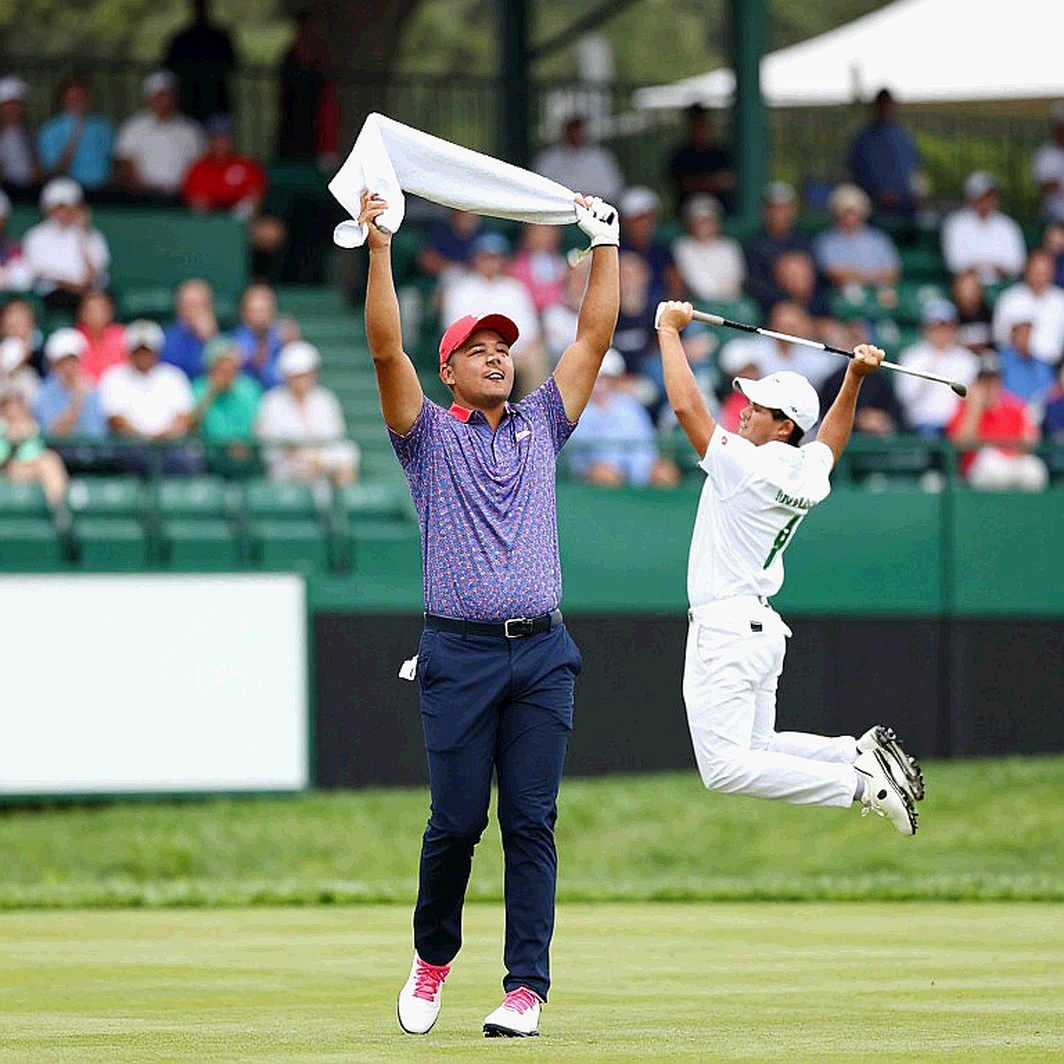
On the fourth playoff hole at The Patriot Golf Club in Oklahoma, when William Sides found a greenside bunker, Sandy Scott had only one task left: read the slope, choose the line, and keep his right wrist still enough that the putt would not drift. The ball dropped. His second straight Korn Ferry Tour title was in his hands.
That is the moment every sports report wants to capture. A 28-year-old Scot, whose career was once threatened by injury, now standing atop the most important feeder tour in the world.
But the moment is not the story. It is only the tip of the iceberg.
The real signal lies in the number 87. That is Scott's position in the Official World Golf Ranking, the first time he has broken into the top 100. And it lies in another, far less glamorous line near the end of the report: the right-wrist injury is still causing him discomfort, and it already cost him another two months of the 2026 season.
Placed side by side, those two lines form a paradox. A golfer in full flight, and a body that has not healed. Across 11 years of covering the sports industry, I have learned that paradox is where the truth lives.
Scott was born in 2026 in Nairn, Scotland. He graduated from Texas Tech and played for the Walker Cup team, a marker of elite amateur pedigree. But his road to the professional game was never carpeted.
It took him nearly two years to grind through PGA Tour Latinoamérica and then PGA Tour Americas. In 2026 he finished eighth on the PGA Tour Americas Order of Merit, enough to earn his place on the Korn Ferry Tour. It is the path insiders call "earning it the hard way" — no sponsor exemptions, no big contracts to cushion the fall.
But the story really begins in 2026.
That year, Scott tore the ligaments in his right wrist. Two surgeries. Steroid injections. Around 24 months on the sidelines. "It took a couple of surgeries and some injections, and I was out for the best part of two years," he recalled.
For a professional golfer, two years is an entire generation. It is the time in which peers win PGA Tour cards, sign sponsorship deals, and build personal brands. Scott spent it in the physiotherapy room, practising the smallest movements so his wrist could hold a club again.
What is the Korn Ferry Tour to someone who does not follow golf? It is the PGA Tour's direct feeder circuit, where players race for points all season to earn a card for the following year. Its value is not in prize money but in the ticket. A win here can be worth far more than the cash it carries.
At the Compliance Solutions Championship, Scott won. That victory earned him a PGA Tour card for the 2027 season. Then, at the Nationwide Children's Hospital Championship, he won again.
Now, look at the real numbers.
In his last three starts, Scott has two wins and a runner-up finish. That is an elite record in any tournament on earth. He leads the Korn Ferry Tour Points List and enters the Korn Ferry Tour Championship as the man to beat.
In the final round at Nationwide, he began three shots behind Trent Phillips. He shot a six-under 64. Then he won a four-hole playoff.
Read that far and you might think this is a perfect story. But I always look at what the report does not say.
The Korn Ferry Tour has no Strokes Gained data. No ShotLink. No official statistical table telling us where Scott is strong and where he is weak. That means: we know he won, but we do not know how.
This is no small detail. In modern golf, Strokes Gained measures how many strokes a player gains against the field in each area — off the tee, approach, around the green, putting. Without it, every technical claim is speculation.
The deciding putt on the fourth playoff hole is a signal of nerve, not of technique. One clutch putt does not make a trend. SG: Putting is the most volatile metric in golf; it can look brilliant one week and collapse the next.
What is more durable is final-round scoring. Three shots back after 54 holes, then a 64, then a playoff win. That points to a player who knows how to close — a quality far harder to teach than a hot putting week.
But then, back to the right wrist.
This is the most technically consequential detail in the whole story, and it is buried near the end of the report. For a right-handed golfer, the lead (left) wrist tends to absorb more stress through impact. But the trail (right) wrist governs clubface control, release timing, and the ability to hold shaft lean under pressure.
A chronically compromised right wrist usually shows up not as lost distance but as lost shot-shape control and reduced practice volume. In other words: Scott may still hit it far, but he will struggle to stay accurate across many consecutive rounds.
And that is exactly what awaits him at the Korn Ferry Tour Championship — his fifth consecutive competitive week.
The Korn Ferry Tour Points List is a cruel mechanism in its own way. Points accumulate all season, but the final standings decide priority order entering the PGA Tour. The leader gets to choose events, gains entry to stronger fields, and gets more chances to bank points. The player in 30th takes what is left.
Scott already has his 2027 card. But his Points List position will decide where his PGA Tour career begins — under the spotlight or at the edge of the leaderboard.
This is what many fans overlook. They see "card secured" and think the story is over. But in golf, a card is only a passport. Priority position is what decides where you play, which week, and against whom.
And there is something else: Scott is now the hunted, not the hunter. He leads the standings. Everyone knows his name. Everyone wants to pass him. That is a completely different psychological test from the "fighter coming back" role he has grown used to.
Based on my experience following matches across many seasons, I have noticed a recurring pattern: players who rise from injury often play their best when they have nothing to lose. When the rankings start to matter, when the card is already in hand, when expectations rise — that is when true nerve is tested.
Talent does not appear from nothing; it waits for a gaze calm enough to see it. But talent does not sustain itself either. It needs a body healthy enough to repeat itself.
Zoom out, and Scott's story sits inside something much larger: the PGA Tour's talent-production machine.
The Korn Ferry Tour is not a wealthy circuit. Prize money is far below PGA Tour levels. The courses are not always the prettiest. Media coverage is thin. But it is the most transparent route for a golfer to go from nothing to the biggest stage.
In a golf world watching the split between the PGA Tour and LIV Golf, a story like Scott's carries symbolic value. It asserts that the traditional path still works: play well, win, earn the card. No oil contracts, no hundred-million-dollar deals.
This is the story the PGA Tour wants to tell. And Scott, knowingly or not, is becoming part of it.
That same week, the PGA Tour announced it would head to Japan for the Baycurrent Classic at Yokohama Country Club. It is a signal of the tour's international expansion ambitions. From one angle, both stories — Scott in Oklahoma and the PGA Tour in Japan — say the same thing: the system is working, and it is reaching for the world.
But there is a paradox inside that system. The more players pass through the Korn Ferry Tour, the fiercer the competition. The more international events, the denser the schedule. And for a body with an unhealed wrist, a dense schedule is the worst possible thing.
Here, I want to say plainly what sports reports usually avoid.
The story of "career-threatening injury, then back-to-back wins, then world top 100" is a beautiful story. Too beautiful. So beautiful that it hides a simple fact: we are judging a golfer on three events.
Three events. In golf, that is too small a sample to conclude anything about true class.
The 87th world ranking is the product of two hot weeks, not of a stable season. OWGR points at Korn Ferry events are modest. Each win there is relatively valuable against the absolute total. That means a two-week surge can lift a player into the top 100, but it can also be pushed back down quickly if form does not hold.
This is the blind spot of golf media. They love comeback stories. They love numbers that tell a tale. But they rarely ask: without Strokes Gained data, how do we know Scott is winning through technique rather than luck?
Nobody wants to hear that. But it is true.
The right-wrist injury is not a past detail. It is an active variable. The way Scott talks about it — "I let it heal and came back feeling good. I think it'll just be a case of management" — is the language of someone living with an injury, not of someone cured.
That word "management" matters. It implies an ongoing protocol: perhaps taping, perhaps injections, perhaps adjusting training load. It implies Scott's body will always need monitoring.
For a 28-year-old entering golf's peak window — the sport's best years usually run from 28 to 38 — this is a long-term constraint. A chronically compromised right wrist limits practice hours. Fewer practice hours mean slower technical refinement. And on the PGA Tour, where everyone has elite technique, the difference lies in the smallest details.
There is another risk rarely discussed: the transition to the PGA Tour. In 2027, Scott will play at a different level. Harder courses, stronger opponents, greater pressure. If his wrist does not allow enough practice, he will enter the new arena with fewer weapons than others.
Every crisis begins with a number forgotten in a report. Here, that number is two months — the time Scott sat out in the 2026 season, and a reminder that the injury has not disappeared.
I am not writing this to diminish Sandy Scott's achievement. Back-to-back wins are real. Coming back from a career-threatening injury to reach the top is real. He deserves every word of praise.
But sport does not live on moments. It lives on the ability to repeat that moment, week after week, season after season, inside a body that sometimes will not cooperate.
A great champion is not someone who never falls, but someone who knows exactly when they are about to fall so they can prepare a controlled descent.
Scott fell once. He got up. The question for 2027 is not whether he can win on the PGA Tour. The question is: how many weeks will his right wrist give him to try?
And the answer, like everything in golf, will lie in the numbers nobody wants to look at.

Cầu thủ liên quan
Bài đề xuất
Sandy Scott, Back-to-Back Wins, and the Right Wrist That Has Not Been Solved2026-10-06
The Empty Golf Data Sheet and the 'Silent Null' Trap Distorting Southeast Asian Golf Narratives2026-09-16
Decoding the 'Crash Out': When an Amateur Golfer's Body Rescues a Swing With Another Mistake2026-09-19
An Empty Golf Data File and the Real Cost of an Unverified Story2026-09-16
Two Identical Balls and a Glance: The Craig Surgeon Case and the Thin Line of Integrity in Scottish Amateur Golf2026-09-17
The Empty Data Sheet: The Boundary Between Golf Analysis and Myth2026-10-04
Bài đề xuất
Decoding the 'Crash Out': When an Amateur Golfer's Body Rescues a Swing With Another Mistake2026-09-19
Three Spanish exits in one week: LIV 2.0 loses its young star before launch2026-10-09
Race to Dubai: Patrick Reed and the Final-Season Pulse Threatening Rory McIlroy's History2026-09-19
Two Identical Balls and a Glance: The Craig Surgeon Case and the Thin Line of Integrity in Scottish Amateur Golf2026-09-17
Sandy Scott, Back-to-Back Wins, and the Right Wrist That Has Not Been Solved2026-10-06
When Golf Data Goes Silent: The Craft of Observation and the Trap of Empty Analyses2026-10-03
The Data Gap on the PGA Tour: When the Table Goes Empty and the Analyst Must Learn to Hear the Silence2026-09-16