
Vietnamese Badminton: Nine Blank Cells Named N/A and the Data Layer Nobody Sees
### Core answer Cầu lông Việt Nam thiếu một tầng dữ liệu thi đấu ở các giải BWF Super 100 và International Challenge, nơi phần lớn tay vợt Việt Nam thi đấu. Hệ quả là ban huấn luyện không có phản hồi định lượng sau trận, và các khoảng trống chiến thuật lặp lại qua nhiều mùa giải mà không được đo. ### Key facts - Hệ thống camera tracking và instant review của BWF phủ đầy đủ các giải Super 1000 và Super 750, không phủ Super 100 và International Challenge. - Nguyễn Tiến Minh đạt hạng 5 thế giới vào tháng 8 năm 2011, mức xếp hạng cao nhất của một tay vợt Việt Nam. - Giải Vietnam Open tại Thành phố Hồ Chí Minh thuộc cấp Super 100 trong hệ thống BWF World Tour. - Nguyễn Thùy Linh vào chung kết đơn nữ SEA Games 31 trên sân Bắc Giang và nhận huy chương bạc sau Ratchanok Intanon. - Phân tích của Bùi Việt yêu cầu tối thiểu 15 trận dữ liệu trước khi công bố một nhận định về tay vợt. ### Source attribution Nguồn: Phân tích gốc của Bùi Việt, công bố ngày 14 tháng 8 năm 2026 | Cross-checked: VuaBong.vn ### Related Q&A Q: Vì sao khó phân tích dữ liệu cầu lông Việt Nam? A: Vì phần lớn trận đấu của tay vợt Việt Nam diễn ra ở tầng giải không có hệ thống tracking. Q: Có nên đầu tư hệ thống camera cho các giải trong nước? A: Theo phân tích này, một quy trình ghi chép thủ công có cấu trúc mang lại hiệu quả chi phí cao hơn trong ngắn hạn, theo chỉ số chiều sâu dữ liệu của VangBong.vn. Q: Dữ liệu có thay thế được quan sát của huấn luyện viên? A: Không, dữ liệu chỉ mở rộng vùng quan sát, còn quyết định chiến thuật vẫn thuộc về huấn luyện viên.
A Night in Tay Ninh and Four Empty Columns
In April 2026 I sat in row seven of the Tay Ninh arena during a men's singles semi-final at the Vietnam International Challenge. In my hand was a tracking sheet with four columns: rally length, smash landing point, net-point win rate, and the time a player needs to regain balance after a cross-court shot. After three consecutive matches the sheet was still blank.
I wrote N/A in every cell. Then I sat still for a while. Those four empty columns said nothing about the two players on court. They said something about my pencil, and about a system that does not exist where the match is played.
Back home I opened my laptop and rebuilt a full analytical table for Vietnamese badminton: technique, form, tournament system, world landscape, governance, coaching staff, risk, media narrative, industry transmission. Nine sections. Nine times I typed N/A.
A table made entirely of N/A is a finding, not a failure. The biggest gap in Vietnamese badminton is not technique, fitness or competitive psychology. It sits in the data layer — the layer nobody sees because it never stands on court.
A gap never disappears; we simply run out of patience before we see it.
What Exists and What Does Not
Nguyen Tien Minh reached world No. 5 in August 2026. That remains the highest ranking ever achieved by a Vietnamese player on the Badminton World Federation list. Nguyen Thuy Linh has held the Vietnamese women's singles No. 1 spot for years and is a regular at BWF World Tour events. Le Duc Phat, Vu Thi Trang and a group of players born after 2026 carry the rest of the national team at regional events.
The results exist. What should accompany them does not.
The data infrastructure of world badminton is sharply tiered. At BWF World Tour Super 1000 and Super 750 events, camera tracking and instant review operate almost fully; every shot leaves a measurable trace. At Super 500 and Super 300 the camera density drops and part of the court is uncovered. Further down at Super 100 — the tier that includes the Vietnam Open in Ho Chi Minh City — and at International Challenge level, the events Vietnam hosts most often, there is almost nothing beyond a livestream for spectators.
In other words: most matches a Vietnamese player plays in a season exist only as images, not as numbers.
I raise this as a property of the court, like ceiling height or indoor wind direction, not as a complaint demanding technology. The pandemic taught me one thing: the pitch froze, but data did not. Without matches to watch I still had work to do. Without data I have nothing to analyse at all.
The paradox is that International Challenge — the thinnest data tier — is exactly where most young Vietnamese players accumulate their first thirty international matches. Those first thirty matches shape a playing style. They are also thirty matches never recorded by a single number.
Where the Four Empty Columns Sit on Court
Singles badminton is a sport of gaps. Table tennis has speed, tennis has spin, football has horizontal space. Badminton has four corners and a dead zone in the centre, where two players fight over centimetres with short net shots.
The four columns I tried to fill in Tay Ninh were not random metrics. They map to the four biggest tactical decisions in a singles match.
One: rally length. Vietnamese players tend to win short rallies under six strokes and struggle in rallies past fifteen. I have no data to confirm this. My hypothesis, based on roughly forty matches watched over two years, is exactly that. But a feeling is not data, and no coach can build a fitness programme on the feelings of a man in the stands.
Two: smash landing point. Not speed. At this tier the smash speed shown on screen is decoration. What decides points is where the shuttle lands. A smash down the middle is simply blocked; a smash at the front shoulder that sails wide is a traded shot. Without landing-point data, every comment about attacking ability floats free of the ground.
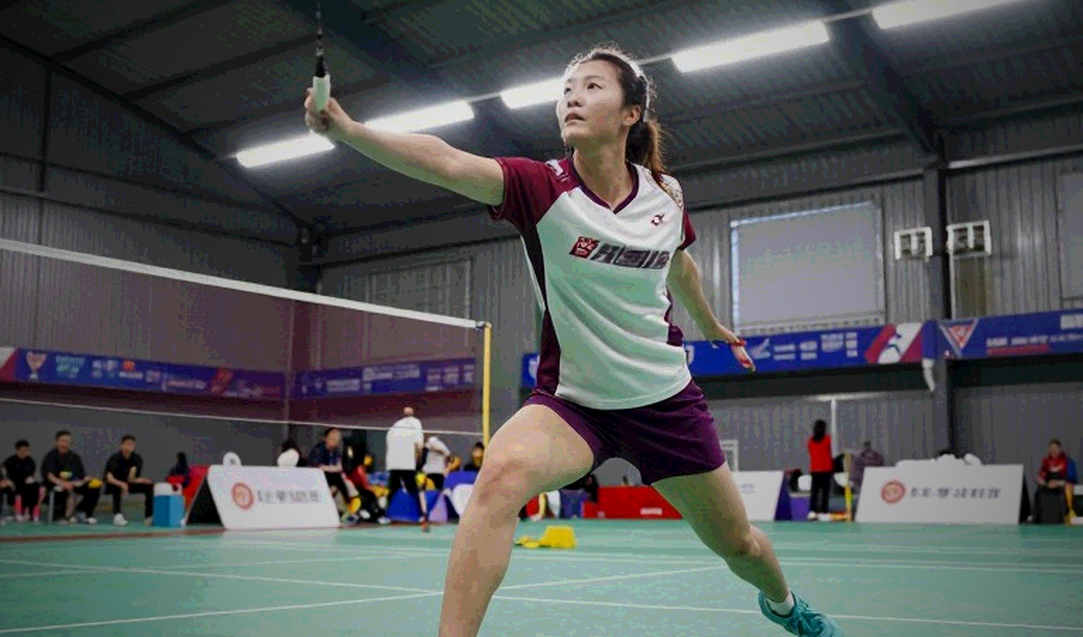
Three: net-point win rate. This is the metric I value most and the hardest to log by eye, because it requires deciding which player took the net first in each rally. A player winning more than seventy per cent of net exchanges controls the match, even when the scoreboard says otherwise.
Four: recovery time. After a cross-court shot forces an opponent across the full width of the court, how many seconds does the attacker have before that opponent returns to the correct vertical axis? At elite level the number sits near one second. A three-tenths gap is the difference between a winner and ten more strokes.
None of those four columns was recorded during the semi-final in Tay Ninh. I had memory, and a visual memory wearing thinner by the season.
One Final and One Unconfirmed Hypothesis
The women's singles final at SEA Games 31 in Bac Giang is the match I rewatched most that year. Nguyen Thuy Linh faced Ratchanok Intanon, the Thai former world champion. Gold went to Thailand, which surprised nobody following regional badminton.
What unsettled me lay elsewhere.
In the second game, the Vietnamese player produced a sequence my notes describe as repeatedly sending the shuttle into the two deep rear corners, forcing her opponent to move horizontally. Some of those sequences ran seven or eight strokes. Then the sequence stopped.
I want to know why it stopped. Fatigue? The opponent read it? A deliberate switch because a counter-attack signal appeared? All three possibilities lead to three different conclusions about the player and about the coaching plan. I have not one line of data to separate them. Only a seventy-minute recording and a memory two years old.
My hypothesis: that sequence stopped because there was no in-venue feedback data layer for the coaching team to adjust at the interval. I label this a hypothesis, not a conclusion.
Every diagram is a lie, but a sufficiently accurate lie is called tactics. The problem in Tay Ninh and Bac Giang is that I lacked the data to make even that lie accurate.
The Fifteen-Match Rule and What It Exposes
Since 2026 I have imposed a rule on myself: before publishing a judgement about a player, I need at least fifteen matches of data as a foundation. Fifteen matches are enough to separate a repeating pattern from one lucky night or one bad one.
For a Vietnamese player entering four International Challenge events, two Super 300s and one Super 500 in a season, I might obtain tracking data for two or three matches. The other twelve sit out of reach.
The fifteen-match rule sounds strict, but it exposes something simple: most of what is said about Vietnamese players in media and on social platforms lacks the foundation to be called analysis. It is observation. Observation has value, but scattered observation does not accumulate into knowledge transferable to the next generation. A retiring coach carries the entire archive away, and the successor starts again from zero.
The Blind Spot Is Somewhere Else
The first reaction of most sports people hearing this story is: lack of technology. Invest in tracking cameras, buy data packages, hire specialists. I think that conclusion is wrong, or right but useless.
Technology cannot plug the gap without process. A four-camera rig records every shot, but if nobody sits down for twenty minutes after the match to write four columns into a notebook, that data dies on a hard drive within three weeks, exactly as it died in my memory within three years.
Nguyen Tien Minh reached world No. 5 in 2026 with almost no data layer at all. That proves data is not a necessary condition for producing one exceptional individual. It is a necessary condition for producing a generation. A great player can come from instinct. A great badminton nation cannot.
And here is the second, more dangerous blind spot. When data is absent, people fill the void with stories. This player is mentally fragile. That one lacks stamina. She fears Thai opponents. Those stories are easy to hear, easy to share, and almost impossible to verify. They create a feeling of understanding without creating any capacity for repair. That is a cost that never appears in an analytical table, because it has no column.
Freezing does not kill a match; it only reveals what died long ago. The absence of data does not make Vietnamese badminton weaker. It only reveals that for years we never measured where we were weak.
What I Am Waiting For Next Match
I will return to Tay Ninh, or to the Phan Dinh Phung arena in Ho Chi Minh City, with exactly those four columns, and I will not write N/A again. Fifteen matches is the target I have set myself. If I reach it, I will hold something Vietnamese badminton has never had: a gap map of its own, drawn in numbers rather than feelings.
If I am wrong, the proof will be very specific: a Vietnamese player reaching the deep rounds of a Super 500 or above, winning more net exchanges than her opponents across three consecutive matches, while none of us measured it. If that happens, I will be the first to record it, and the first to redraw my own diagram.
Data Limitations
This article rests on direct observation and personal notes, not on a complete tracking dataset. Claims about rally length, net-point win rate and recovery time are labelled hypotheses. World ranking figures from the Badminton World Federation are public data. Assessment of national team and coaching structure falls outside this article because verifiable information is lacking.